Virtual smartphone tickets vs. Interactive kiosks: Which reception solution to choose?
Today, waiting is the main friction point in the customer journey. Whether in a retail store, a public administration office, or at the entrance to a tourist site, poor reception management can drastically reduce satisfaction and conversion rates. To digitize queues, two main approaches compete in the market: the traditional model based on physical interactive kiosks, and the new software approach (SaaS) relying on virtual tickets via the visitor's smartphone.
Which of these solutions is best suited to your ROI, customer experience, and flexibility goals?
Let's break it down !

Physical interactive kiosks: a classic model showing its limitations
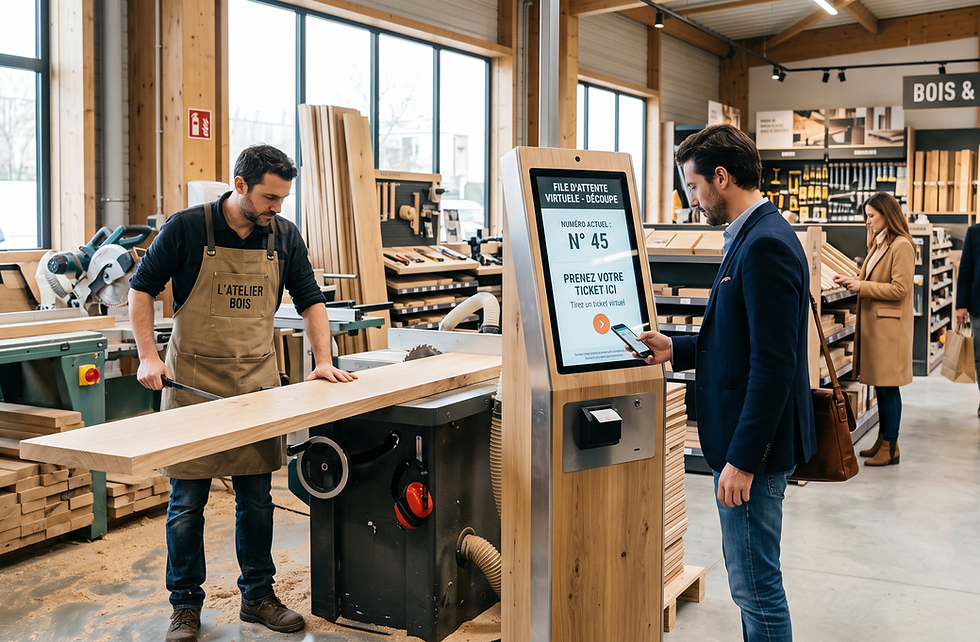
For a long time, ticket dispenser kiosks (the famous touch-screen terminals at venue entrances) were the only technological solution to queues.
Its historic advantages:
Familiarity: Visitors have gotten used to looking for a kiosk upon arrival.
Default inclusion: It requires no equipment on the user's part, as it prints a paper ticket.
Why this model is being questioned today:
While kiosks organize the queue, they do not eliminate it. Worse, they often create a new queue... just to reach the kiosk itself (the infamous "bottleneck effect" at the entrance). On top of this, venue operators face heavy hidden costs: hardware purchases (often several thousand euros), on-site maintenance fees, constant buying of paper rolls, and a degraded CSR footprint due to printing thousands of single-use tickets. Finally, since the health crisis, the public has become increasingly reluctant to use shared touchscreens.
Virtual smartphone tickets (SaaS / BYOD): the new standard in reception management
The "Bring Your Own Device" (BYOD) principle has established itself as the standard in reception management. Rather than supplying hardware, the facility relies on the tool that 95% of its visitors already have in their pocket: their smartphone. How it works is seamless: visitors scan a QR code at the entrance (or click a link on your website), select their reason for visiting, and receive their virtual ticket directly on their screen, with no download required.
The key benefits of paperless flow management:
Waiting becomes "active": This is the true ROI driver of this solution. Since customers receive real-time notifications ("It's almost your turn"), they no longer need to remain static. In Retail, they continue browsing the aisles (increasing average basket size). In tourism, they enjoy the gift shop or cafeteria.
Zero hardware maintenance (SaaS): No broken screens, no paper jams. The solution updates remotely and instantly.
Ultra-fast and cost-effective deployment: Printing a few posters with a QR code costs infinitely less than wiring and anchoring a metal kiosk.
Data collection (with consent): Digital ticketing allows you, if desired, to collect contacts to build visitor loyalty or send post-visit satisfaction surveys.
The Match: Physical Kiosks vs. Smartphones
Criteria | Interactive Kiosk (Hardware) | Virtual Smartphone Ticket (SaaS) |
Investment Cost (CAPEX) | High (hardware purchase, installation, wiring) | Very low (software subscription, QR code signage) |
Maintenance & Consumables | High (repairs, thermal paper rolls) | Virtually zero (software maintenance managed by provider) |
Customer Experience (Waiting) | Passive: Customer must stay near the call screen | Active: Customer is free to move around, notified via push/SMS |
CSR Impact | Negative (hardware manufacturing, paper waste) | Positive (zero paper, eco-designed software) |
Data Collection | Limited (basic flow analytics) | Rich (phone/email, instant satisfaction surveys, retargeting) |
Accessibility: h ow to manage visitors without smartphones?
This is often the main argument raised by defenders of physical kiosks: "What about members of the public affected by the digital divide, particularly in the public sector?" At Affluences and Lineberty, we firmly believe that inclusion does not require heavy infrastructure investments.
The solution lies in a hybrid reception model:
Digital self-service (for 90% of visitors): Online appointment booking in advance or on-site QR code scanning via smartphone.
Assisted human reception (for the remaining 10%): Instead of a cold, impersonal kiosk, your front-desk staff (equipped with a simple tablet or directly from their service counter) can manually add visitors without smartphones to the same virtual queue and issue them an SMS ticket or a printed appointment receipt.
This approach guarantees universal and humanized care for those who need it, while massively decluttering your lobby thanks to visitors using their own phones.
Software agility wins over hardware constraints
Investing in a queue management solution should no longer mean installation work and unpredictable maintenance costs. By turning your visitors' own smartphones into queue tickets, you not only improve their waiting experience, but you also drastically reduce pressure on your staff while generating additional value (cross-selling, customer loyalty).
Ready to digitize your reception and free up your spaces? Discover how Affluences and Lineberty's crowd and virtual ticketing management solutions transform the visitor experience without any heavy hardware investment.